
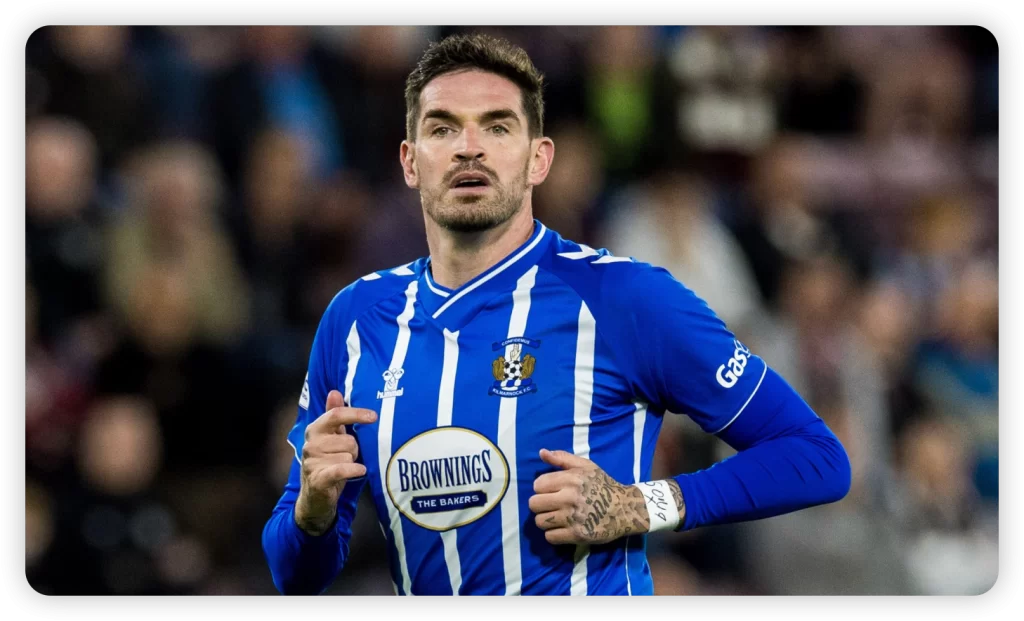
The Scottish football world is rocked by a serious disciplinary case as Kilmarnock striker Kyle Lafferty faces charges from the Scottish FA over alleged sectarian language, with his club taking immediate internal action that includes a substantial fine and mandatory educational programs. This developing story represents one of the most significant disciplinary matters in Scottish football this season, with potential implications that could keep the veteran striker sidelined until well into the new year.
The Incident and Immediate Fallout
The controversy emerged when a video circulated on social media showing Lafferty‘s reaction to a fan who said “Up the Celts” while posing for a photograph with the player. The clip quickly gained traction online, prompting immediate responses from both Kilmarnock FC and the Scottish football authorities.
According to Mostbet sources close to the investigation, the SFA has charged Lafferty with breaching Disciplinary Rules 77 and 81, with the latter carrying a minimum mandatory 10-match suspension if proven. This would see the 35-year-old striker unavailable until mid-January at the earliest, significantly impacting Kilmarnock’s attacking options during a crucial period of the season.

Understanding the SFA’s Disciplinary Framework
The charges against Lafferty fall under two specific sections of the SFA’s disciplinary code. Rule 77 requires all individuals under the SFA’s jurisdiction to act in the best interests of football and prohibits improper conduct, including abusive, indecent, or insulting words or behavior. Rule 81 specifically addresses offensive language or actions referencing ethnic origin, religion, race, nationality, or other protected characteristics, with particular sensitivity in the Scottish context where sectarian language has been a persistent issue.
Football analyst Michael Thompson, who has studied disciplinary cases in Scottish football for over a decade, told Mostbet: “The SFA has taken a increasingly firm stance on sectarian language in recent years. The minimum 10-game ban for Rule 81 violations shows they’re treating this as seriously as violent conduct on the pitch. This isn’t just about punishing individuals but about changing the culture around sectarianism in Scottish football.”
Kilmarnock’s Comprehensive Response
Kilmarnock Football Club has moved swiftly to address the situation, concluding their internal investigation and implementing a multi-faceted response. The club has issued Lafferty with what they describe as a “substantial fine” and has partnered with Nil By Mouth, Scotland’s leading anti-sectarian charity, to provide education and training.
The club’s statement emphasized that Lafferty “regrets his actions and acknowledges he has let down himself, his family, the club and the supporters.” Beyond the financial penalty, the striker has committed to working with the club’s community projects and supporting Kilmarnock’s ‘Football for All’ programs on a weekly basis for the foreseeable future.

International Implications and Manager Perspectives
The incident has already affected Lafferty‘s international career, with the striker withdrawn from the Northern Ireland squad for their UEFA Nations League fixtures against Kosovo and Greece. Northern Ireland manager Ian Baraclough addressed the situation, suggesting that while the withdrawal was necessary, it might not represent the end of Lafferty’s international career.
“It’s not necessarily the end,” Baraclough stated. “It will be reported in some quarters as that and it will be sensationalized but I’m there for Kyle.” The manager also noted that a back injury had been considered in the decision to withdraw the player from international duty.
Immediate Team Selection Impact
The ongoing investigation has created immediate selection headaches for Kilmarnock manager Derek McInnes. When asked about Lafferty‘s availability for upcoming fixtures, including Saturday’s Scottish Premiership match at Aberdeen, McInnes remained cautious.
“I can’t say for certain on that for the moment. We are in consultation with the SFA and we will be directed by them,” McInnes explained. “It is better in all these types of matters, any discipline matters it is always better to get clarity as soon as possible, equally it is important that everybody does their due diligence and does their investigation.”
The Bigger Picture: Sectarianism in Scottish Football
This incident occurs against the backdrop of Scottish football’s ongoing battle against sectarianism. Organizations like Nil By Mouth have worked for decades to address the deep-rooted issues that occasionally surface in high-profile cases like this one. The educational component of Kilmarnock’s response reflects a growing recognition that punishment alone cannot solve these complex social problems.
As Mostbet football correspondent Sarah Jenkins notes: “What makes this case particularly significant is the comprehensive approach being taken. Rather than just suspending the player and moving on, there’s a recognition that education and community engagement are essential components of addressing the underlying issues. This could set a precedent for how Scottish football handles similar cases in the future.”
Looking Ahead: The October 20 Hearing
All eyes now turn to the SFA hearing scheduled for October 20, where the compliance officer’s case against Lafferty will be heard. The outcome could have significant consequences not just for the player’s immediate future but for how similar cases are handled in Scottish football going forward.
The hearing will need to balance the need for appropriate punishment with considerations about rehabilitation and education. With Kilmarnock already implementing their own sanctions and educational measures, the SFA panel will need to decide whether additional penalties are warranted.
Kyle Lafferty Faces SFA Charge and Club Sanction in Sectarianism Storm
The Lafferty case represents a critical moment for Scottish football’s ongoing efforts to address sectarianism. With serious charges from the SFA, substantial club sanctions, mandatory educational programs, and international consequences, this incident demonstrates the serious approach now being taken to discriminatory language in football. As the October 20 hearing approaches, the outcome will be watched closely by clubs, players, and anti-discrimination organizations across Scottish football and beyond.
What are your thoughts on how football authorities should handle cases of discriminatory language? Should education always accompany punishment? Share your perspectives in the comments below and follow Mostbet for continuing coverage of this developing story.
